
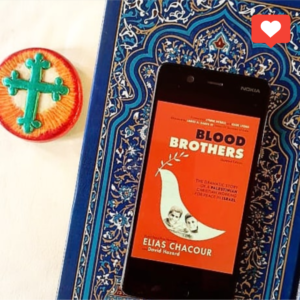
3-time Nobel Peace Prize-nominated Catholic priest Father Elias Chacour was born in British Mandate Palestine in 1939 to a family of Palestinian Christians. In his book Blood Brothers, Father Elias Chacour shares his personal story of war, fear, statelessness, suffering and his decision to respond to the turmoil in his life and the region with reconciliation and peace. Father Elias Chacour begins Blood Brothers (first published in 1982) by describing his childhood in the hills of upper Galilee in the 1930s.
He was a 9-year-old boy when the Middle East was completely uprooted and transformed in 1948 through war and death. In the book, he asks the questions that any child would ask after being forced out of their home and village with nowhere to go: when can I go home? Elias was sent to school in Haifa with instructions from his father to “learn how to reconcile enemies, how to turn hatred into peace.” This young boy witnessed things no child should see: the dead and buried bodies of his neighbors and the humiliation and sorrow of his elders. But he also dreamt of peace.
“God is watching us. You have to be strong.”
Throughout his childhood and adolescence, images of this peace kept recurring in young Elias’ mind who knew that the only way to make that happen was to follow Christ. For Elias, this meant attending seminary. Nineteen year old Elias had graduated from minor seminary in Nazareth, and had his heart set on attending seminary in Jerusalem. But, this was not easy for someone like Elias, who was a Palestinian. So he was sent to seminary in Saint Sulpice in Paris instead.
“Were there only two choices left to us – surrender to abuse or turn to
violence?”
In Europe, Elias discovered what it meant to be Palestinian and learned of the treatment of European Jews. He saw how this had disastrous repercussions in his homeland and he came closer to understanding how he would serve God – as a peacemaker. He returned to his homeland and from transforming a church and entire community in Ibillin to interacting with his fellow pupils from the region in Hebrew University, Father Elias Chacour began to preach the Christian message of peace and reconciliation to a global audience increasingly moved to listen to the rare voice of a Palestinian Christian.
For those looking for a personal understanding of this conflict from a Christian’s point of view, Blood Brothers can help people understand what a Christian solution to conflict should look like. Former United States Secretary of State, James A. Baker (in George H.W. Bush’s administration) writes the afterword to ‘Blood Brothers: The Dramatic Story of a Palestinian Christian Working for Peace in Israel’ and shares that “the great gears of history sometimes grind up the lives of innocent people.”
“If someone hurts you, you can curse him. But this would be useless. Instead, you have to ask the Lord to bless the man who makes himself your enemy. And do you know what will happen? The Lord will bless you with inner peace – and perhaps your enemy will turn from his wickedness. If not, the Lord will deal with him.”
Elias father, after learning that his fig orchards were taken from him and sold to European settlers.
Blood Brothers is filled with moving stories of Father Elias Chacour’s childhood and his ongoing work to bring together two communities in need of peace, understanding and reconciliation.
PRAYER
Dear Lord, in the land of your birth, life, death and resurrection, and in the land of the early Church, there is everything but peace. Many of us have not been in this situation, so we cannot understand what those living in the region are going through. So, we borrow the prayer that Elias Chacour’s mother prayed in the 1940s: “Forgive them, oh God. Heal their pain. Remove their bitterness. Let us show them your peace.” In the name of our Lord, amen.
DID YOU KNOW?
Father Elias Chacour was nominated for the Nobel Peace Prize three times – in 1986, 1989 and 1994. In the early 1970s, he organized a non-violent peace march in Galilee with Bishop Joseph Raya, a friend of Dr. Martin Luther King Jr.